If you are looking for yoga classes in Hove, you’ll quickly discover that there is a lot of choice. Brighton and Hove have thriving yoga communities, offering everything from spiritual styles like Kundalini, to dynamic styles like hot yoga and more traditional approaches such as Iyengar yoga.
Having lots of choice is a good thing, but it can make it difficult to know where to start. Yoga classes can be very different from one another, not only because of the style being taught, but because of the teacher’s experience, the level of the class and the amount of individual attention you receive.
Some students want to improve flexibility, while others come because they want an alternative to the gym, to become stronger and to improve their posture.
The important thing is finding a class and teacher that suit you.
Different Styles of Yoga in Hove and Brighton
Anyone searching for yoga in Hove or Brighton will come across a number of different styles.
Some classes are fast moving and physically demanding. Others are slower and place more emphasis on relaxation. You will also find hot yoga, flow-based classes, restorative yoga and classes combining elements from several traditions.
There is nothing wrong with trying different styles. It can be a useful way of discovering what you enjoy. However, I think it is worth finding out what you are actually going to be taught before joining a class.
These days the word “yoga” covers a very broad range of approaches. Yoga was developed over millennia as a complete system for the mind, body & spirit, without any ‘extras’ required. A traditional Yoga class would not use sound bowls, group therapy, or music, or kittens or goats; these are ‘new age’ add ons that some people find to be fun.
Iyengar yoga is a particularly traditional and methodical form of yoga. We pay close attention to alignment and to how the body is working within each pose. Poses are taught progressively and the sequence of poses is carefully considered.
This is one of the reasons I was drawn to Iyengar yoga myself and why I have continued to teach it for thirty years.
You can read more about Iyengar yoga and how it is taught on my Iyengar YogaIyengar Yoga page.
What to Look for When Choosing Yoga Classes in Hove
If you search for “yoga classes near me” in Hove, distance is probably going to be one of your first considerations. A class reasonably close to home is certainly easier to attend regularly; But I wouldn’t choose a yoga class on location alone.
Look at the teacher’s qualifications and experience. A properly trained teacher should understand not only how to teach the poses, but how to adapt them when somebody cannot perform the standard pose. A newly qualified teacher will obviously have less experience.
This becomes increasingly important as we get older. Most classes contain people with different levels of flexibility, strength and mobility, and students may arrive with old injuries or areas of stiffness.
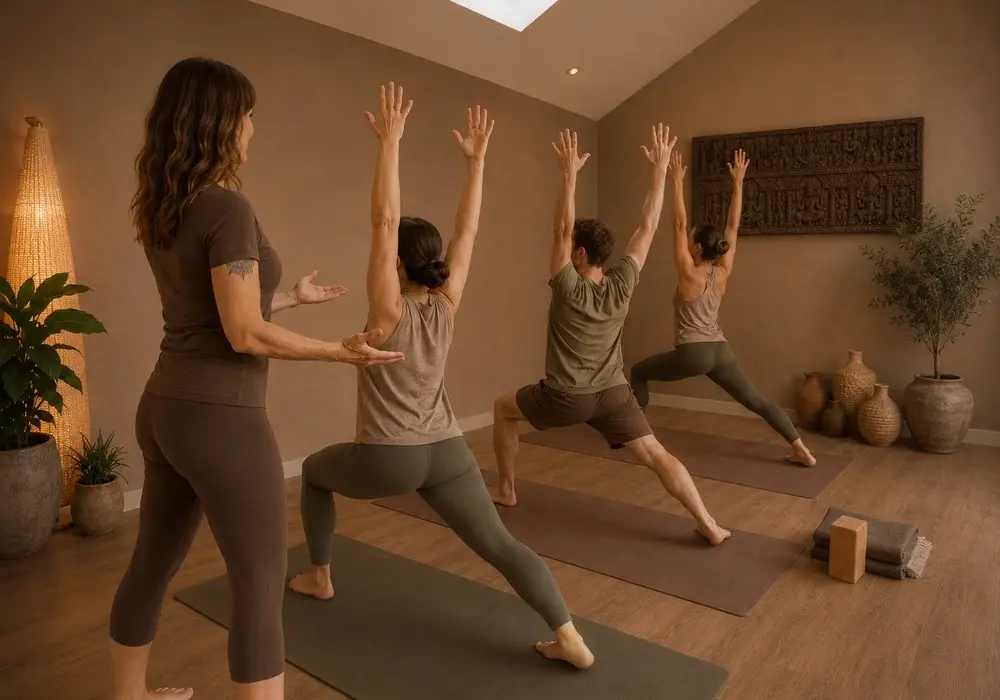
Iyengar yoga is known for careful hands-on adjustments when required, while most fast-flowing styles the teacher will practice on their own mat and not touch anybody. The use of yoga equipment can be extremely helpful. Blocks, belts, blankets, bolsters and chairs aren’t simply there to make poses easier. Used correctly, they can help a student understand the action of a pose and work with better alignment.
You should also consider the class level. Most importantly, you should feel that you are being taught rather than simply following along.
Why Iyengar Yoga Might Be Right for You
I teach Iyengar yoga in Hove because I believe its structured approach works particularly well for students with different bodies, levels of experience and reasons for coming to yoga.
Iyengar yoga was developed by B.K.S. Iyengar and is known for its attention to alignment, precision and logical sequencing.
That doesn’t mean we are trying to make every pose look perfect.
The aim is to understand how your body is working. Sometimes a relatively small adjustment to the position of a foot, leg, shoulder or pelvis can completely change the way a pose affects the body and therefore the mind.
We also use props where appropriate. A belt might help you work more effectively when tightness restricts movement. A block can bring the floor closer to you. A chair or wall can provide support while allowing you to explore an action that would otherwise be difficult.
There is also a strong emphasis on progression. You don’t need to be flexible before you begin yoga and you certainly don’t need to be able to perform complicated poses. You start with the foundations and gradually build strength, stability, mobility and understanding.
For me, stability should come before trying to achieve greater depth in a pose.
Beginner, General and Intermediate Yoga Classes
Choosing the right level is important when looking for yoga in Brighton and Hove.
You may find classes in your local church hall, as part of a health club or gym, or with independent teachers like me. I teach on New Church Road and on Portland Road in Hove, as well as online.
Beginner Yoga Classes
A beginner class is suitable if you have never done yoga before or have only attended a few classes. If you’ve tried some online Yoga such as Yoga Vastu or Yoga Selection, it’s still a good idea to start some face to face classes as a beginner.
You will learn basic standing poses and some of the fundamental actions that occur repeatedly throughout yoga practice. I like to explain what the benefits of each pose are.
There is a lot to take in when you first begin, so don’t worry if you cannot remember the names of poses or every instruction.
General Yoga Classes
The most common class found is called a ‘General class’ as there may be a range of experience within the class.
An Iyengar general class will continue working on the foundations while gradually introducing a wider variety of poses, including standing and seated poses, forward extensions, twists, backbends and introductory inversions. There are even some other schools of yoga where you will do the same poses in every single class.
Intermediate Yoga Classes
Intermediate classes are for students with a more established yoga practice, and require more intense focus, rather than simply more difficult poses.
Students are expected to understand the basic actions of poses and be familiar with a broader range of asanas. Poses like inversions really need to be taught face to face.
Progression in Iyengar yoga isn’t simply about doing increasingly difficult shapes. It is also about developing greater awareness, precision and understanding. Breathing techniques (pranayama) are actually considered to be more difficult than physical poses (asanas), and therefore are taught more at intermediate level.
What to Expect in Your First Yoga Class
It is completely normal to feel slightly apprehensive before your first class, particularly if you think everyone else will be more experienced than you.
Flexibility is not a requirement for starting yoga. In fact, many people begin precisely because they feel stiff. However, to join a group class you should be in generally good health.
If you’ve recently had an operation, for example, a beginner’s group class will not be suitable for you.
That’s because when there are multiple students with health issues, a general class simply cannot accommodate many additional needs.
In an Iyengar yoga class, the teacher will normally demonstrate poses and give clear instructions before and while you practise them. You may be given an alternative way of working if something isn’t appropriate for you.
You may also be surprised by how much concentration yoga requires. When you are concentrating on your feet, legs, spine, shoulders and breathing, there isn’t much room to think about your shopping list or what you need to do tomorrow. This is one of the aspects of yoga that many students find particularly valuable.
You don’t need expensive yoga clothing either. Wear something comfortable that allows you to move freely. We work in bare feet. If you have an injury or medical issue that might affect your practice, tell your teacher before the class begins.
Regular Yoga Practice
As with most things, regular practice makes a difference.
That doesn’t mean you need to practise yoga for an hour every day. A short, focused home practice can be extremely useful alongside attending a weekly class. Even 15 minutes practised consistently can be more beneficial than an ambitious hour-long practice that may rarely happen.
A class gives you the opportunity to learn new poses, have your alignment corrected and develop your understanding. Home practice allows you to explore what you have learnt for yourself. Many students come to me for one to one sessions on an ad hoc basis, as and when needed to boost their own practice.
Over time, poses that initially felt awkward often become more familiar. You become more aware of how you stand and move and begin to recognise where you habitually hold tension.
Finding the Right Yoga Classes in Hove
Brighton and Hove is fortunate to have a large and varied yoga community. My advice is not to worry too much about finding the “best” yoga class. Instead, find a well-qualified teacher and a style that makes sense to you.
A good class should challenge you without making you feel that you need to compete with the people around you. You should be able to ask questions and, when necessary, be given an appropriate alternative way of working.
Most of all, you should feel that you are learning something rather than just going through the motions.
Anna’s Iyengar Yoga Classes in Hove
I am a Level 3 Iyengar yoga teacher and have been teaching yoga for 30 years. My yoga classes in Hove are based on the traditional Iyengar method, with an emphasis on alignment, careful sequencing and adapting poses where necessary for individual students. About me.About me.
My classes are suitable for anybody in general good health, even those without much knowledge of Iyengar Yoga. I ensure students can work at an appropriate pace and progress gradually. I specialise in teaching students one to one; sometimes because they may have health issues that make learning in a group situation more challenging, sometimes simply because it’s more convenient for them.
You don’t need to be naturally flexible and you don’t need to have practised yoga for years before joining. What matters is choosing the class appropriate for your current experience.
You can see my current Hove yoga classes, workshops, class times and booking information on the Yoga Classes & WorkshopsYoga Classes & Workshops page.
If you would like to know more about my qualifications and the way I teach, you can read more on my About Anna page. If you’re particularly interested in Iyengar yoga in Hove, my Iyengar Yoga page explains more about the method and what makes it different.
Whether you are completely new to yoga, returning after a break or looking for a more structured way to develop an existing practice, finding the right teacher and class can make a considerable difference.